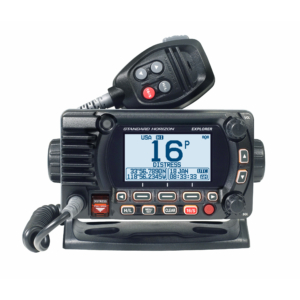
Standard Horizon GX-1400E VHF MOBILE MARINE RADIO / GPS

Description
The Standard Horizon GX-1400E is an ultra-compact fixed-mount VHF marine radio (156 × 61 × 100 mm), making it an excellent choice for small and medium-sized motorboats and sailing yachts. The radio complies with the ITU-R M493-14 Class D DSC standard, features a built-in GPS receiver, and supports ATIS identification for European inland waterways.
One of the Standard Horizon GX-1400E's key advantages is its dedicated DSC receiver, which continuously monitors Channel 70 and can receive DSC calls even while you are listening to another channel. In an emergency, the DSC DISTRESS function can transmit a digital MAYDAY message including the vessel's identity and GPS position, significantly enhancing safety at sea.
Recommended Applications
The Standard Horizon GX-1400E is ideal for:
Inland Waterways
- Communication between sailing boats and motorboats
- River navigation and inland waterways
- Vessels operating on the Danube and other European waterways
- Communication with marinas and shore stations
- Vessel-to-vessel communication
- ATIS-compliant operation on inland waterways
Offshore and Coastal Use
- Vessel-to-vessel communication
- Communication between vessels and shore stations
- Routine DSC calling
- DSC distress communications
- Communication between vessels and liferafts
- GPS-based position sharing
The Standard Horizon GX-1400E is particularly recommended for users looking for a reliable, compact marine radio with full DSC functionality.
DSC Safety System and Integrated GPS
The Standard Horizon GX-1400E is a full-featured Class D DSC radio capable of:
- Sending DSC distress calls
- Managing routine DSC calls
- Digital vessel-to-vessel communication
- GPS position transmission
- Automatic DSC channel switching
The built-in 66-channel WAAS GPS receiver provides fast and accurate positioning without requiring an external GPS source for DSC operation.
High-Resolution Dot Matrix Display
The large dot matrix display offers excellent readability in both daylight and nighttime conditions. Enhanced backlighting provides improved contrast and easier operation onboard.
Easy-to-Use E2O Menu System
The intuitive E2O (Easy-To-Operate) menu system allows quick access to DSC functions, GPS settings, and radio configuration, making the radio easy to use for both novice and experienced boaters.
DSC Position Request Function
The Standard Horizon GX-1400E can automatically request and display the GPS positions of up to 6 other vessels via DSC communication. This feature is especially useful for fleets, group cruises, and sailing events.
NMEA0183 Connectivity
The radio includes NMEA0183 input and output ports, allowing easy integration with compatible chartplotters, navigation systems, and other onboard electronics.
Key Features of the Standard Horizon GX-1400E
- Ultra-compact design
- ITU-R M493-14 Class D DSC system
- Built-in 66-channel WAAS GPS receiver
- ATIS support for European inland waterways
- 25W transmit power
- Dedicated DSC receiver for Channel 70 monitoring
- DSC distress calling and automatic channel switching
- GPS position and time display
- NMEA0183 input and output
- Programmable function keys
- Position request for up to 6 vessels
- Large dot matrix display
- E2O menu system
- Programmable scanning
- Priority scanning
- Dual Watch monitoring
- Quick access to 10 favorite channels
- IPX8 waterproof rating (1.5 meters for 30 minutes)
- 3-year manufacturer's warranty
- 3-year waterproof warranty
3-Year Waterproof Warranty
Standard Horizon provides exceptional warranty support for the Standard Horizon GX-1400E. Under normal operating conditions, the radio is covered by a 3-year waterproof warranty, including protection against water damage, reflecting the manufacturer's commitment to quality and reliability.
Standard Horizon HX-210E Marine Radio package contents:
- Standard Horizon GX-1400E Marine Radio
- Mounting Bracket
- 2 Mounting Knobs
- Power Cable with 6A Fuse
- DSC Warning Sticker
- User Manual
ABOUT THE VHF MARINE BAND: The radio frequencies used in the VHF marine band lie between 156 and 158 MHz. The marine VHF band provides communications over distances that are essentially “Line of sight” Actual transmission range depends much more on antenna type, gain and height than on the power output of the transmitter. On a fixed mount 25 W radio transmission expected distances can be greater than 15 miles, for a portable 5 W radio transmission the expected distance can be greater than 5 miles in “Line of sight”. The use of Marine VHF radio is governed by regulation and local laws. Use by unauthorized persons is not permitted and is subject to fines and confiscation if convicted. This is especially true when the radio is used on land in a non marine environment where because of location or propagation anomalies es-pecially during the summer, the transmission may cause interference with a search and rescue operation or contribute to a marine collision between pass-ing ships.
Customers are advised that the service centre for marine radio equipment is located outside Hungary. Due to the time required to ship the equipment to the service centre abroad, carry out the repair and return the equipment, repairs can only be completed within the timeframe specified by the service centre on a case-by-case basis, which may exceed 30 days. The Seller will inform the Customer of the expected repair timeframe in every case.
Why choose Anico?
With your purchase, you receive more than just a device: you also benefit from the expertise of Anico. Why trust us?
- Expert support: We have several decades of experience in the world of two-way radios and radio communication systems.
- Official source: We distribute only genuine, factory-original products, sourced directly from the manufacturer.
- Warranty and service: Our own professional service centre and expert advice are available to support you even after your purchase.
- Community: Follow us on Facebook and watch our YouTube videos, where we share practical tips on how to use transceivers.
Blog posts related to the product:
IP Protection of Transceivers
Puzzles of Encryption: Safe Utilisation of Transceivers in Our Days
What to Know About Transceiver Batteries and their Charging
(Near) Perfect positional accuracy with GPS transceivers
All about VHF radios: frequency, range, MMSI code, ATIS code, DSC call, licences
| GENERAL | |
| Channels | European |
| Normal Input Voltage | 13.8 VDC ±20% |
| Current Drain Standby | 0.3 A |
| Receive (at Maximum AF Output) | 1.2 A |
| Transmit | 5.0 A (Hi); 1.0 A (Lo) |
| DSC Transmitted Call Log | 30 |
| DSC Distress Call Log | 30 |
| DSC Received Call Log | 50 |
| Individual Directory | 60 |
| Group Directory | 30 |
| Display Type | 2.6” x 1.4” (55 x 31 mm) Full Dot Matrix (102 x 56 pixels) |
| Dimensions (W x H x D) | 6.14" x 2.40" x 3.94" (156 x 61 x 100 mm) |
| Flush-Mount Dimensions (W x H x D) | 5.16" x 1.97" x 4.72" (131 x 50 x 120 mm) |
| Weight | 1.76 lbs (800 g) |
| TRANSMITTER | |
| Frequency Range | 156.025 MHz to 161.600 MHz (Inter National) |
| RF Output | 25 W (Hi); 1 W (Lo) |
| Conducted Spurious Emissions | Less than –80 dB (Hi); –66 dB (Lo) |
| Audio Response | within +1/–3 of a 6 dB/octave pre-emphasis characteristic at 300 to 3000 Hz |
| Audio Distortion | Less than 5 % |
| Modulation | 16K0G3E (for Voice), 16K0G2B (for DSC) |
| Frequency Stability | ±0.0003 % (–4°F to +140°F (–20°C to +60°C)) |
| FM Hum and Noise | 50 dB |
| RECEIVER | |
| Frequency Range | 156.050 to 163.275 MHz |
| Sensitivity | 20 dB Quieting 0.30 μV 12 dB SINAD 0.25 μV Squelch Sensitivity (Threshold) 0.13 μV |
| Modulation Acceptance Bandwidth | ±7.5 kHz |
| Selectivity (Typical) | Spurious and Image Rejection 75 dB for Voice (70 dB for DSC) Intermodulation and Rejection 70 dB for Voice (70 dB for DSC) |
| Audio Output | 4.5 W (at 4 ohms external speaker output) |
| Audio Response | within + 1/–3 of a 6 dB/octave de-emphasis characteristic at 300 to 3000 Hz |
| Frequency Stability (–4°F to +140°F (–20°C to +60°C)) | ±0.0003 % |
| Channel Spacing | 25 kHz |
| DSC Format | European version:Meets ITU-R M493-14 |
| INTERNAL GPS RECEIVER (GX1400GPS and GX1400GPS/E only) | |
| Receiver Channels | 66 Channels |
| Sensitivity | Less than –147 dBm |
| Time to First Fix | 1 minute typical (@Cold Start) 5 seconds typical (@ Hot Start) |
| Geodetic Datum | WGS84 |
| NMEA 0183 INPUT/OUTPUT Sentences | |
| 4800 Baud selected | NMEA 0183 Input (4800 baud) GGA, GLL, GNS, RMC, GSA, & GSV NMEA 0183 Output (4800 baud) DSC, DSE, GGA*, GLL*, GNS*, RMC*, GSA* & GSV*38400 Baud selected:NMEA 0183-HS Input (38400 baud) GGA, GLL, GNS, RMC, GSA, & GSV NMEA 0183-HS Output (38400 baud) DSC, DSE, GGA*, GLL*, GNS*, RMC*, GSA* & GSV* |
Reviews
2 rating
Write a review!
Andrei Bezzabarov
|
Verified purchase
02/10/2023
Great marine radio for affordable price
Tudoroiu Ligian
|
Verified purchase
02/07/2022
Lipsa stoc